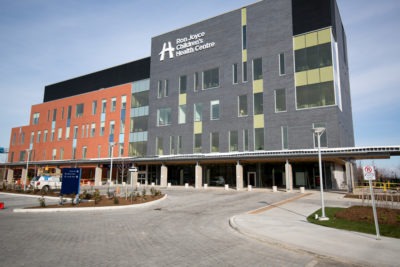
The Technology Access Clinic (TAC) serves children and adults with neurological, developmental and/or multiple disabilities. Our mission is to facilitate the communication of individuals who are not able to write due to a long-term physical disability and/or whose speech does not meet all of their communication needs.
TAC is an Augmentative and Alternative Communication Clinic (AAC) which serves all of Hamilton-Wentworth, Brant, and Haldimand-Norfolk regions. TAC is approved by the Assistive Devices Program (ADP) of the Ministry of Health and Long Term Care to prescribe communication devices for individuals who cannot use speech for face-to-face communication or hand writing for written communication.
Our team offers assessment, treatment, and consultation services.
Assessment is typically done in the clinic, but follow-up consultations are done in the client home, school or community placement. Clients are often followed long term over many years as their communication needs change.
We Value:
- the worth of all clients referred to Hamilton Health Sciences and respect their right to communicate;
- a client-centered and collaborative partnership, where needs are jointly identified, goals are agreed upon and decisions and actions are taken by all parties involved
- capacity-building through a team approach, which provides clinical expertise and resources needed to attain the best communication and writing solution for our clients.
Care We Provide
- Assess client needs and abilities for augmentative and alternative communication (AAC)
- Determine eligibility for Assistive Devices Program (ADP) funding (Scroll down to Funding for more information.)
- Prescribe the most appropriate communication and writing system, and access method for clients
- Recommend strategies for using the AAC system
- Train facilitators who assist the client in using their AAC system
- Provide ongoing support for the client, family, school and others to promote communication in all daily living activities
- Provide technical support in the client’s environment(s)
- Host workshops and presentations for clients and caregivers
- Offer information regarding AAC, specialized access and communication technology for community groups, school boards
- Provide student placements
Team Members
You and/or your family member will work closely with one or more of the following team members:
- Occupational Therapist (OT)
- Speech-Language Pathologist (S-LP)
- Communicative Disorder Assistant (CDA)
- Rehabilitation Technologists
- Program Secretary
- Business Clerk
Funding for AAC
During our assessment process, we determine a client’s eligibility to receive ADP funding for the lease or purchase of a communication aid or writing system. The most appropriate system for the client and family is prescribed to meet personal communication needs in the home. Individuals with a primary diagnosis of Learning Disability are not eligible for ADP funding.
What is Assistive Devices Program (ADP)
ADP, funded by the Ministry of Health and Long Term Care, provides financial assistance to Ontario residents with long-term physical disabilities to obtain basic, competitively priced, personalized assistive devices to give them increased independence and control over their lives. For example: wheelchairs, hearing aids, orthotics, and AAC systems (Communication Aids).
https://www.ontario.ca/page/communication-aids
If you are purchasing an AAC device:
ADP provides up to 75% (up to a maximum allowable amount) of the purchase price of ADP eligible face-to-face or written communication aids, depending on which ADP eligibility criteria you or your child meet.
Families are responsible for the remaining 25% of the purchase price, unless you or your child receives:
- Assistance for Children with Severe Disabilities (ACSD)
- Ontario Disability Support Program (ODSP)
- Ontario Works Program
Families are also responsible for Harmonized Sales Tax (HST), and/or shipping and handling fees.
If you are leasing an AAC device:
Some clients are eligible to lease equipment through ADP. Your AAC clinicians will help you determine if you qualify for this option. ADP will cover 95% of the annual leasing cost. Families are responsible to pay the remainder, and associated HST costs. The maximum a family will be charged is $1000.
Additional Funding: Additional financial assistance may be available through third-party funding sources, such as other community agencies, insurance benefits or local service clubs. Your TAC clinician can provide documentation needed for the application.
Family-Centered Care
At McMaster Children’s Hospital, the care we provide reflects what matters most to our patients and families. Based on what patients and families have told us, we will:
Communicate
- Get to know you and your family and treat you with dignity and respect
- Work together as a competent team
- Communicate with each other and your family about your child’s care
- Give you prompt feedback on your child’s progress
Collaborate
- Ensure you understand the health concerns about your child
- Partner with you in decisions about your child’s care
- Help you learn skills to take part in your child’s care
- Plan the next steps in your child’s care together
Respond
- Respond promptly when you or your family need help
- Include persons who are important to you in your child’s care
- Provide a convenient, accessible, child-friendly, welcoming environment
- Seek and respond to your family’s comments about our care
Referral Process
Who can make a referral?
Anyone can! However, a physician’s signature is required to confirm the client’s diagnosis.
What are the referral criteria?
We see clients of all ages. They must:
Live in the Hamilton-Wentworth region and surrounding areas.
Have a valid Ontario Health Card number.
Have a physical disability.
How do I make a referral?
- Download or print a referral form here: TAC Referral Form.
OR
Contact us for a hard copy: (905) 521-2100 ext 77833.
- Please read important instructions on the Cover Page before completing the form.
- Attach any additional information.
- Mail or fax the completed form to the clinic (address and fax number are on the referral form). It is recommended that you make a copy before mailing us the original.
What happens next?
- You will receive a letter acknowledging that we have received your referral. The client will be placed on our waitlist. Please contact us if you do not receive this confirmation letter.
- You will be contacted to schedule a pre-assessment meeting when the client is nearing the top of the waitlist. If you have any questions, please call us at (905) 521-2100 ext. 77833, or e-mail: tacinfo@hhsc.ca